Marquand Park Foundation, P.O. Box 415
Lover's Lane, Princeton NJ 08542
Marquand Park Foundation, P.O. Box 415
Lover's Lane, Princeton NJ 08542
Marquand Park and Arboretum is a 17-acre historic preserve of trees and woodlands that offers a variety of recreational and educational experiences in the center of Princeton. Originally the landscaped garden of a 19th-century estate, the park has a rich collection of native and exotic trees reflecting the interest and tastes of its previous owners and its current beneficiaries. Some trees in the parks are the largest of their kind in New Jersey.
Click to enlarge
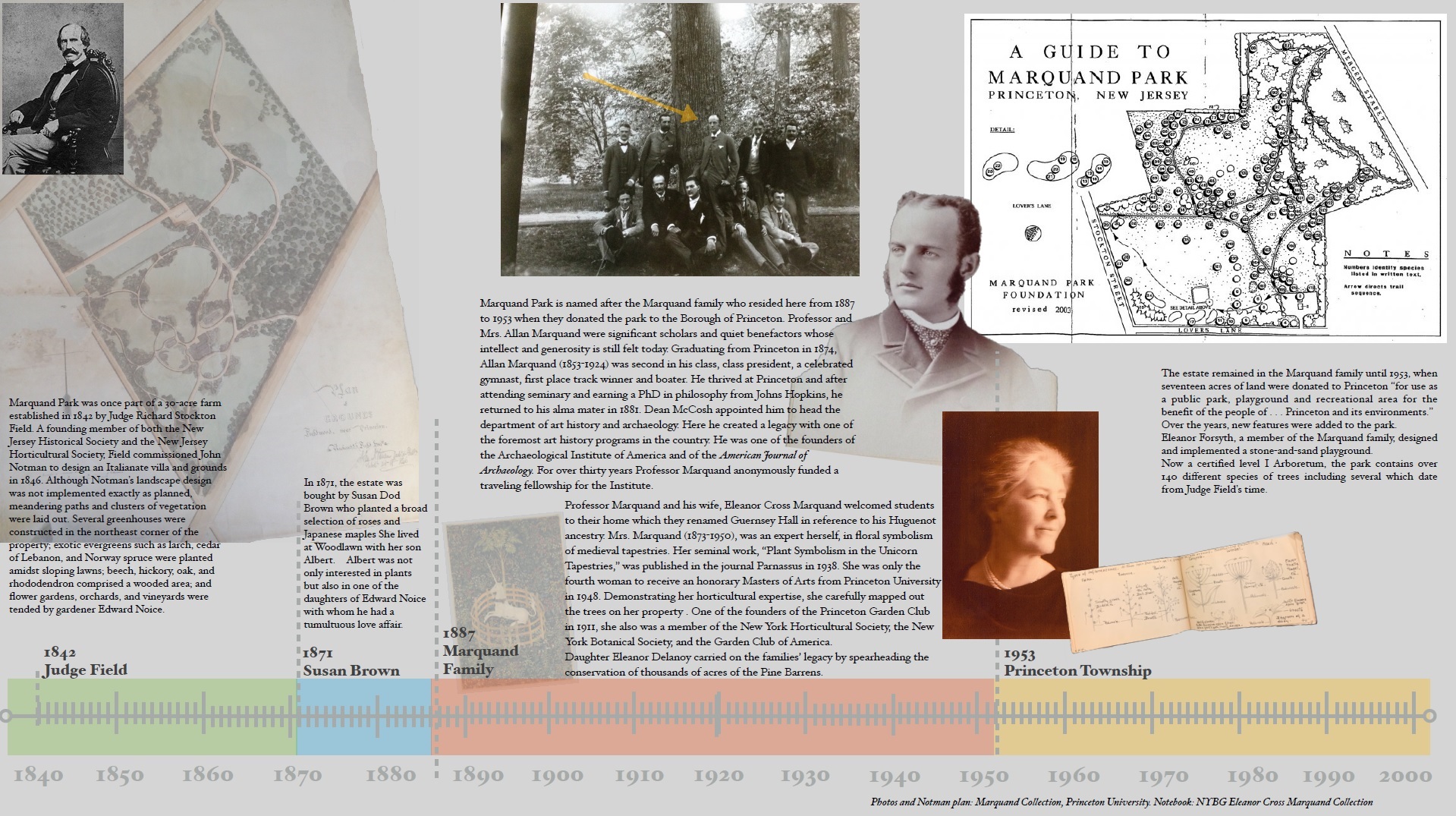
Marquand Park is a classic example of a 19th century landscaped garden and was once part of the Woodlawn estate purchased in 1842 by Richard Stockton Field, a successful lawyer and professor at Princeton University. Field had a great interest in gardening and was the founder and first president of the New Jersey Horticultural Society. In 1846, he commissioned John Notman, a Philadelphia architect, to design a landscaped garden and later a mansion for his property.**
The garden was developed first. We do not know how closely the 1846 Notman design was followed but both Field and Notman had direct knowledge of A. J. Downing’s principles of gardening*** and his picturesque style is still very present in the current layout of the park. Field was fortunate to secure the services of an experienced gardener, Edward Noice, to oversee the work. Early plantings included native oaks, beeches, a Cedar of Lebanon, white pines, rhododendrons, and a Japanese Arbor Vitae. Although most of the property was designed as a landscaped garden, a wooded area along Mercer Street remained relatively untouched and is still the home of some of the park’s oldest trees, many 200 years or older. An Italianate mansion was added to the property around 1855.
In 1871, the estate was bought by Susan Dod Brown. She lived at Woodlawn with her son Albert. Albert was not only interested in plants but also in one of the daughters of Edward Noice with whom he had a tumultuous love affair. Allan Marquand, an art history professor at Princeton University, bought the estate in 1887 and renamed the mansion Guernsey Hall after the island home of his Huguenot ancestors. The estate remained in the Marquand family until 1953, when seventeen acres of land were donated to Princeton ” for use as a public park, playground and recreational area for the benefit of the people of . . . Princeton and its environments.”
Over the years, new features were added to the park. Eleanor Forsyth, a member of the Marquand family, designed and implemented a stone-and-sand playground. A baseball field was located where once must have been an orchard. However, some of the original features of the park with its meandering paths, clusters of trees, wide vistas, and a relatively untouched wooded area are still present. The park not only has a wonderful historic collection of trees and shrubs but is also a remarkable example of 19th century landscape architecture that needs to be preserved.
**Constance M. Greiff and Wanda S. Gunning, “Princeton’s Mythical Gardener”, Vol. LXXIV, 1, Autumn 2012, pp 9-33.
*** A. J. Downing, A Treatise on the Theory and Practice of Landscape Gardening, Adapted to North America: With a View to the Improvement of Country Residences, 1841
Pedestrians can access Marquand Park from Mercer Street, or Stockton Street. The main entrance and the parking lot are on Lovers Lane. Link to Google map
Paved walks meander through the lawn areas and woodlands. Some paths still follow the park’s original 19th-century landscaped garden design.
Marquand Park includes in its collection over 140 different tree specimens, among them some rare evergreens and a Dawn Redwood, known only as a fossil until 1944 when it was discovered growing in China. In the wooded area are huge specimens of native trees such as beech; hickory; and black, white and red oaks. The park’s tree planting program ensures the continuous acquisition of new trees.
The park has three types of signs for identifying trees. Some trees in the landscaped area have signs with just the tree’s name and no park logo or QR code. The numbers on these signs correspond with the numbers in the “Guide to Marquand Park.” Currently, we are replacing these signs with new signs displaying a Marquand Park Foundation logo and a QR code. The QR code provides a link to the description of the characteristics and origins of the tree. Finally, round metal tags with just numbers are used on trees in the woodlands on the east side of the park. The numbers on the new signs and tags correspond with the numbers in the park’s Tree Inventory. Go to Arboretum and Tree Inventory, to access the tree descriptions.
A playground with a sand area surrounded by large boulders is located a short distance from the parking lot. It is a Princeton favorite for families with young children. A drinking fountain is close by.
A baseball diamond is located in the north-west lawn area of the park.
Benches are placed throughout the park, and several picnic tables are close to the parking lot.
The park is open from dawn to dusk. No smoking or drinking of alcoholic beverages is allowed. There are no restrooms in the park. Dogs are welcome in the park but must be leashed at all times.